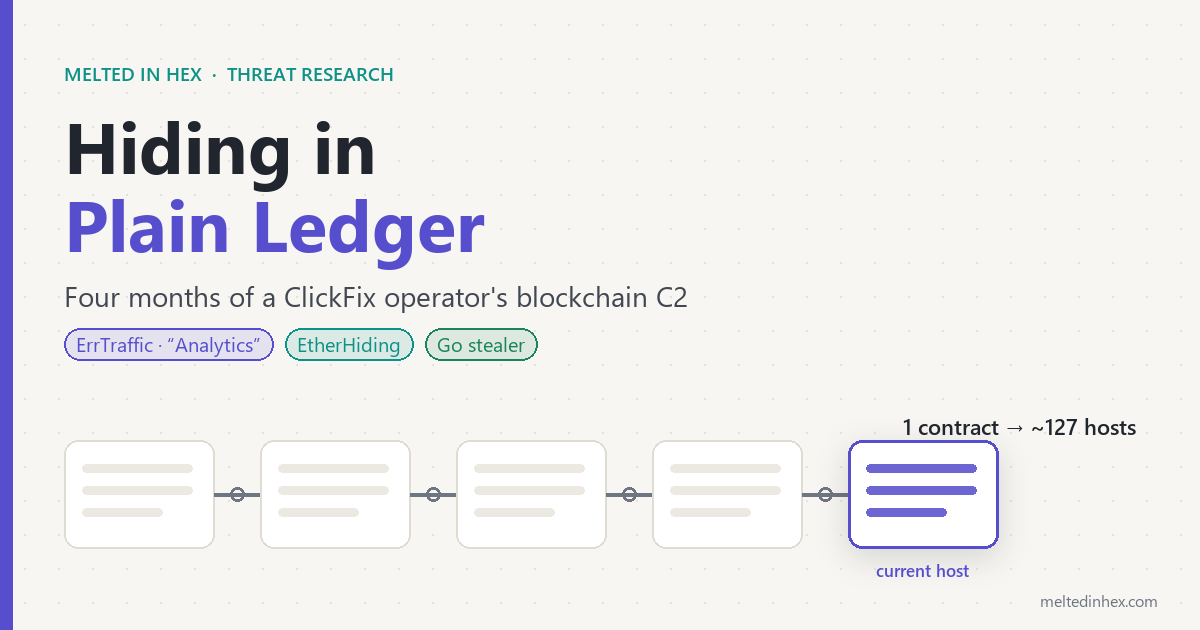
Hiding in Plain Ledger: Four Months of a ClickFix Operator's Blockchain C2

Hiding in Plain Ledger: Four Months of a ClickFix Operator's Blockchain C2

To hide its command-and-control server, this operation writes the address onto a public blockchain. That makes the C2 impossible to seize or sinkhole — but it also means every time the operator moves servers, they leave a permanent, timestamped entry in a ledger anyone can read. I pulled that ledger. It runs to four months and roughly 127 delivery hosts from a single smart contract, and it was still updating the day I looked. ...
July 16, 2026 · 12 min · 2369 words · Melted in Hex
Dead Drops on the Blockchain: Reversing a DPRK npm Loader (PolinRider)

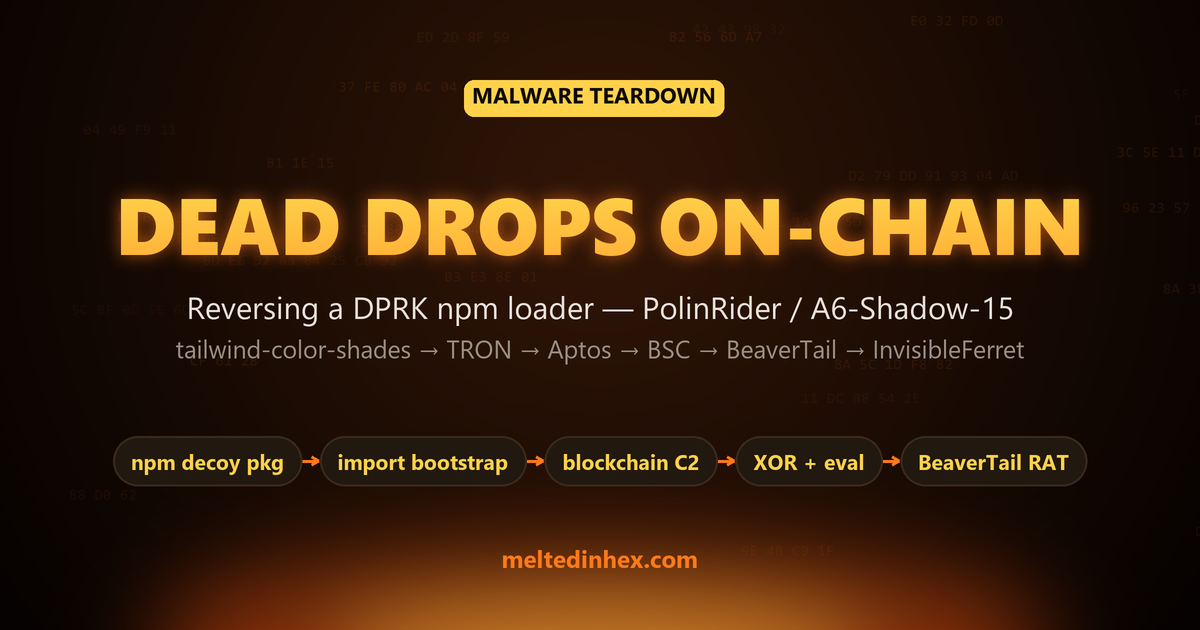
Dead Drops on the Blockchain: Reversing a DPRK npm Loader (PolinRider / A6-Shadow-15)

We have all trained ourselves to look for the call home: the hard-coded IP, the suspicious .xyz domain, the base64 URL that decodes to something hostile. This loader has none of that. Strip it to nothing and you find an address on the TRON blockchain, which points to a Binance Smart Chain transaction sent to a burn address so it can never be spent or deleted. The next stage sits in that transaction’s data field, XOR-encrypted. You cannot sinkhole it, and you cannot file a takedown against an immutable transaction replicated across thousands of nodes. The technique has a name, EtherHiding, and it turns a public blockchain into bulletproof, censorship-proof storage for malware. ...

June 22, 2026 · 23 min · 4692 words · Melted in Hex