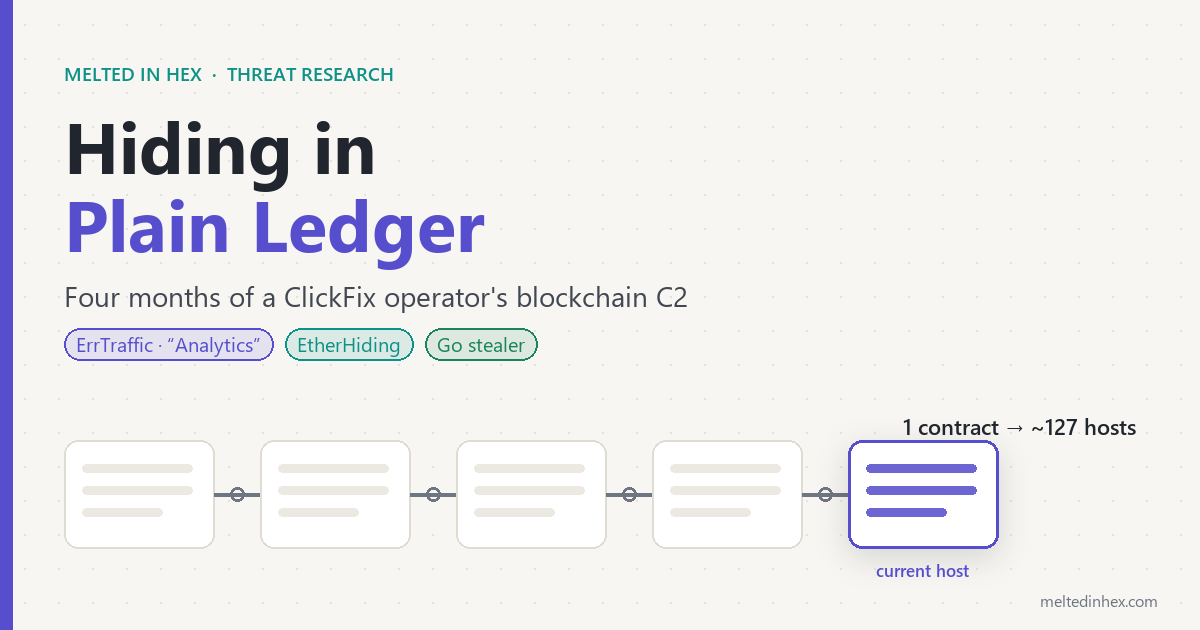
Hiding in Plain Ledger: Four Months of a ClickFix Operator's Blockchain C2

Hiding in Plain Ledger: Four Months of a ClickFix Operator's Blockchain C2

To hide its command-and-control server, this operation writes the address onto a public blockchain. That makes the C2 impossible to seize or sinkhole — but it also means every time the operator moves servers, they leave a permanent, timestamped entry in a ledger anyone can read. I pulled that ledger. It runs to four months and roughly 127 delivery hosts from a single smart contract, and it was still updating the day I looked. ...
July 16, 2026 · 12 min · 2369 words · Melted in Hex
AnalystAIPack: Giving an AI Agent a Malware Analyst's Working Knowledge

AnalystAIPack: Giving an AI Agent a Malware Analyst's Working Knowledge

Ask a general-purpose AI agent to analyze a suspicious executable and you get confident-sounding mush. It will happily tell you to “check the file for anything malicious,” suggest a plugin that does not exist, or skip the one step that actually matters. The model knows a lot about malware analysis. What it lacks is the analyst’s working knowledge: which Volatility 3 plugin to run on a memory image, how to reach a packer’s original entry point, how to turn a recovered C2 config into a Sigma rule, and, just as important, when not to trust a result. ...

July 1, 2026 · 5 min · 1041 words · Melted in Hex
Dead Drops on the Blockchain: Reversing a DPRK npm Loader (PolinRider)

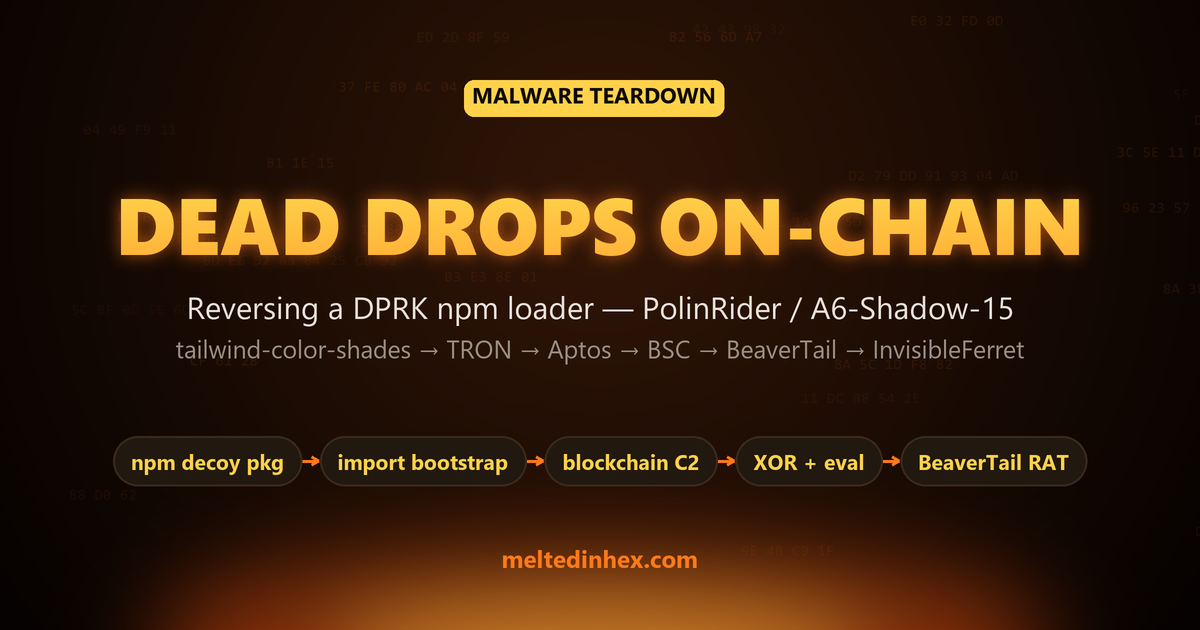
Dead Drops on the Blockchain: Reversing a DPRK npm Loader (PolinRider / A6-Shadow-15)

We have all trained ourselves to look for the call home: the hard-coded IP, the suspicious .xyz domain, the base64 URL that decodes to something hostile. This loader has none of that. Strip it to nothing and you find an address on the TRON blockchain, which points to a Binance Smart Chain transaction sent to a burn address so it can never be spent or deleted. The next stage sits in that transaction’s data field, XOR-encrypted. You cannot sinkhole it, and you cannot file a takedown against an immutable transaction replicated across thousands of nodes. The technique has a name, EtherHiding, and it turns a public blockchain into bulletproof, censorship-proof storage for malware. ...

June 22, 2026 · 23 min · 4692 words · Melted in Hex
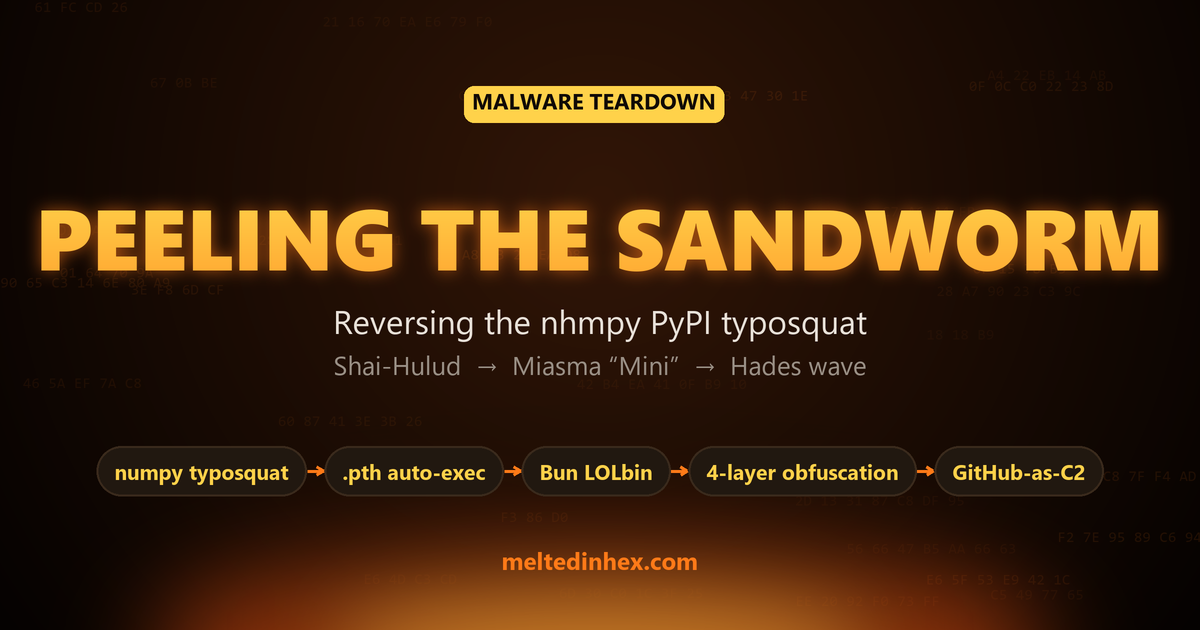
Peeling the Sandworm: Reversing the nhmpy PyPI Supply-Chain Worm

Peeling the Sandworm: Reversing the nhmpy PyPI Supply-Chain Worm (Shai-Hulud / Hades Wave)

The short version A package called nhmpy showed up on PyPI sitting one keystroke away from NumPy (n-h-mpy instead of n-u-mpy). It had already been pulled from the index and the wheel was far larger than NumPy has any reason to be, so I pulled the artifact apart to see what it was really doing. It turned out to be a credential stealer that goes to real trouble not to look like one. The package carries a complete, working copy of NumPy as cover — install it, import nhmpy, and it behaves exactly like the library it’s impersonating. Nothing breaks, so nothing seems wrong. The malice lives in two extra files: a .pth file that runs the instant any Python interpreter starts, and a 5.2 MB JavaScript blob it executes through Bun, a runtime it quietly downloads from GitHub at run time. ...

June 14, 2026 · 18 min · 3694 words · Melted in Hex